.svg "Gorilla ROI")

Article Summary
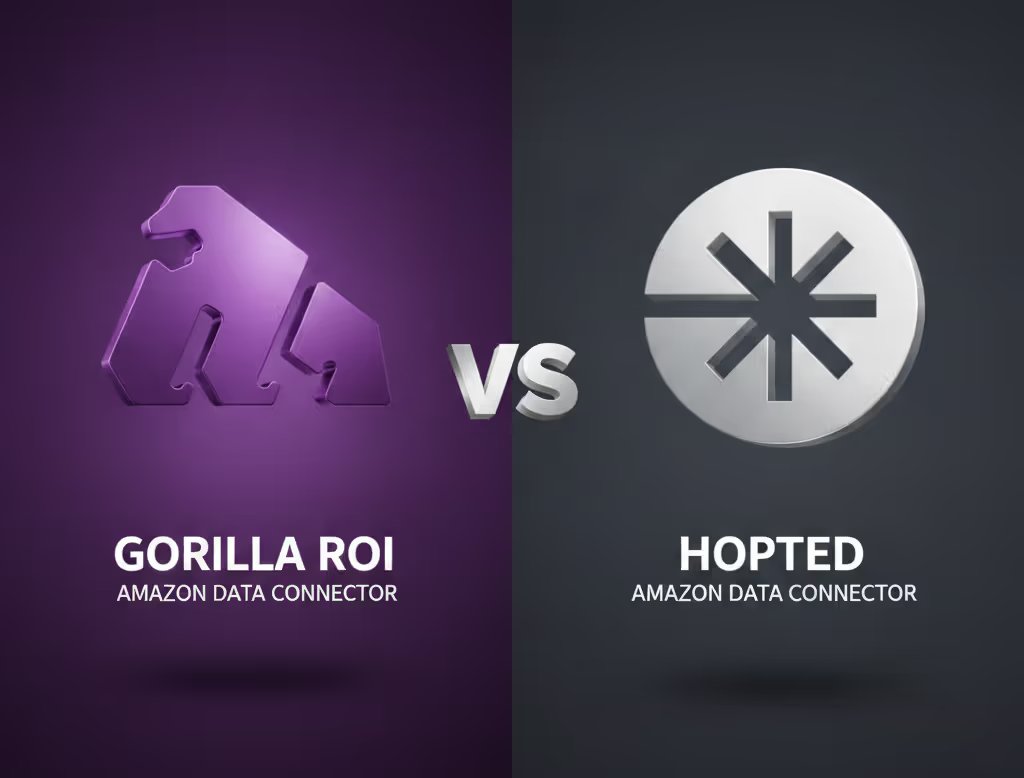
🟤 Both Gorilla ROI and Hopted connect Amazon data to Google Sheets without CSV exports. Gorilla ROI is a point-and-click data hub covering Amazon, Amazon Ads, Shopify, Walmart, TikTok, and Facebook/Meta Ads, used by an 8-figure brand as "the cornerstone for data and decisions." Hopted is a Chrome extension currently limited to Amazon Seller Central.
🟤 Gorilla ROI processes all logic inside the spreadsheet, not the connector, loading 30,000 rows in under 20 seconds. Hopted processes logic inside the browser extension, which slows and freezes as your data volume grows.
🟤 Hopted's write-back feature pushes spreadsheet edits back to live Amazon listings. A single accidental keystroke can overwrite live pricing or inventory across your catalog. Gorilla ROI deliberately does not support write-back.
My wife and I have been selling on Amazon since 2012. We still run a seven-figure Amazon store. I built Gorilla ROI because I was that founder, sitting with my head in my hands late at night, manually exporting reports and fixing broken Google Sheets, thinking there had to be a better way. Over 11,000 teams have installed Gorilla ROI since. Those teams now sync over $313 million in Amazon sales through a single Google Sheet connection.
We have been building Amazon to Google Sheets connectors for over six years, before this became a category. So when another tool writes a comparison article calling us "formula-based, for tech gurus only," I'm going to address that directly.
I recorded a full video breakdown of how Gorilla ROI and Hopted compare, including speed tests, pricing, and which operation each tool fits. Watch it first, then read the full breakdown below.
Gorilla ROI is not a formula tool. It never has been exclusively. The point-and-click sidebar is how the overwhelming majority of our users pull data into Google Sheets. You select your account, choose the report, click import. No formulas required. Formulas exist as an optional advanced layer for teams who want cell-level control. Calling Gorilla ROI "formula-only" is the same as calling Excel "macro-only."
I'll compare both tools honestly here. If Hopted is the right fit for your operation, you should use Hopted. But you should make that decision on accurate information, not on a competitive article built around a false premise.
What Goes Wrong When You Pick the Wrong Connector
The Formula Myth: Set the Record Straight
Hopted's comparison article frames Gorilla ROI as a "formula-based powerhouse" built for "data analysts" and "tech gurus." Their article quotes a reviewer saying the tool is "a bit for advanced level users who actually understands the programming."
That framing is based on how Gorilla ROI worked years ago. It is not how the product works today.
Gorilla ROI has a full point-and-click sidebar interface built directly into Google Sheets. You open the sidebar, select your Amazon account, choose the report type, set the date range, and click to import. The data lands in your sheet immediately. No formula required. No documentation to read. A VA with no technical background can learn it in under 10 minutes.
The formula-based layer exists alongside the sidebar for teams who need cell-level precision: pulling one specific metric into one specific cell, building dynamic reports where data refreshes on a custom schedule. That is an optional power user feature, not the standard workflow.
Hopted uses a point-and-click interface. Gorilla ROI also uses a point-and-click interface. The difference between the two tools is not "UI vs. formulas." The difference is what happens to performance as your operation scales, how many channels the connector covers, and what risks come with each architecture.
What Gorilla ROI Actually Is: A Multi-Channel Data Hub
Gorilla ROI connects ecommerce and advertising data directly into Google Sheets:
- Amazon Seller Central (sales, inventory, returns, fees, reimbursements, FBA data)
- Amazon Vendor Central (sales, inventory, orders, and vendor data)
- Amazon Ads (Sponsored Products, Sponsored Brands, campaign performance)
- Shopify (orders, products, inventory)
- Walmart Seller Center (sales, inventory, performance)
- Facebook/Meta Ads (campaign performance, ad spend, impressions, clicks, conversions)
- TikTok Ads (campaign performance, ad spend, impressions, clicks, conversions)
- TikTok Shop (sales, orders, products, and other ecommerce data)
Hopted connects to Amazon Seller Central. If your brand sells on Shopify or Walmart, your team is still downloading CSVs for those channels and maintaining separate reports. There is no unified view of your business in a single sheet.
For Amazon-only brands, this distinction does not matter today. For any brand running multiple sales channels, it means your multi-channel integrations sit in one place rather than spread across separate tools and manual exports.
With Facebook/Meta Ads now connected, your ad spend, sales, and inventory data across multiple channels can live in one sheet without manual exports. That is when the data hub becomes a genuine competitive moat. Not because of features, but because of what your team can see that a competitor running three separate tools cannot.
Why Teams Call It Their Source of Truth
A source of truth is not a feature. It is what happens when your entire operation stops having multiple versions of the same number.
When Amazon sales, Amazon Ads, Shopify revenue, Walmart inventory, TikTok, and Facebook/Meta Ads, all pull into the same Google Sheet on the same refresh schedule, your team stops reconciling data from four different downloads. There is one number for every metric. Every person on the team sees the same thing. Decisions stop being delayed by the question of which export is current.
Kyle is a co-founder of an 8-figure brand. He has been using Gorilla ROI for over four years across Amazon, Shopify, and Walmart.
He describes how data access changed his team's operating rhythm: "Getting the data, just finding the data and compiling it is critical because it takes a lot of time. If that's done for you automatically, it's really easy to take that and then use your time to think about what needs to be done instead of what data you need to get." His conclusion on what Gorilla ROI is to his business: "Gorilla ROI really is the cornerstone for data and decisions for our business. And we wouldn't be able to operate without it."
Glen Carscadden, Sales Operations Manager at Ridgeline Insights, manages over 40 brands as a full-service Amazon agency.
His team's framing is direct: "Data is the source of truth on Amazon. It's how we track performance, guide our next steps, and fuel new initiatives." Before Gorilla ROI, their team spent hours downloading and manually combining report files. Now: "It is significantly faster than any of our old manual processes. We've reclaimed our time to focus on what really matters, analyzing the results and providing high-level strategy." The full operational breakdown is in the Ridgeline Insights case study.
Cory at Woodies.com puts the scale argument in its simplest form: "Data automation at its finest. I run a 2 million dollar business with 2 employees. Tools like Gorilla allow me to do it."
An 8-figure brand. A 40-brand agency. A $2M operation with 2 employees. None of those are tech-guru use cases. All three describe the same outcome: decisions made from one live sheet instead of a stack of downloaded files.
Performance: What Happens When Data Volume Grows
This is the architectural difference that matters most at scale.
Gorilla ROI sends raw data from Amazon directly into your sheet. All logic, all joins, all calculations happen inside Google Sheets cells. The connector does one job: move data fast. The result is a complete 30,000-row data table loading in under 20 seconds.
Hopted processes logic inside the browser extension before the data reaches the sheet. When the catalog is small, this works. When row counts grow past 10,000, the extension runs out of processing capacity. Refreshes slow. Tabs freeze. The morning reporting cycle that your team depends on starts failing at the worst possible times.
This is not a hypothetical. It is a predictable outcome of building logic into a browser extension rather than keeping the connector as a pure data mover.
A connector should do one thing reliably: move data from the source into the sheet instantly. Everything else belongs in the spreadsheet.
The Write-Back Risk: Hopted's Key Feature Is a Liability
Hopted promotes write-back as its biggest differentiator. The ability to edit a cell in Google Sheets and have that change sync back to your live Amazon listing. As of this comparison, write-back appears to still be in development and not fully live in production.
We built Gorilla ROI with a strict read-only architecture specifically because we saw what happens when spreadsheets have write-access to live seller accounts.
Spreadsheets are collaborative environments. Formulas get edited. Columns get accidentally dragged. Filters get applied and removed. Temporary calculations overwrite permanent values. These are not edge cases; they are daily realities for any team using Google Sheets actively.
When your spreadsheet has write-access to your Amazon account, a single accidental keystroke by a VA doing routine reporting can instantly change live pricing across your catalog. It can alter inventory quantities that trigger automated reorder decisions. It can modify listing attributes that affect Buy Box eligibility.
The damage from a write-back accident is not theoretical. It is immediate and sometimes irreversible within the window that matters.
Gorilla ROI's data flows one direction: from Amazon into your sheet. Edits in the sheet never touch your live account. That is not a missing feature. It is a deliberate operational safeguard.
Pricing: An Honest Comparison
Hopted uses tier-based SaaS pricing based on synced tabs and writeback actions and continues to increase their prices while we look for ways to reduce prices.
- Starter: $30 per month
- Standard: $70 per month
- Plus: $140 per month
Gorilla ROI uses flat-rate pricing based on monthly order volume. The base plan starts at $99 per month for up to 1,000 orders. Pricing scales with order volume from there.
Hopted's pricing is lower at entry level if you only ever use 2 tabs in a spreadsheet. In other words, they want you to pay for any new spreadsheets you need to create.
While being cheaper is accurate and worth acknowledging, it is strictly forces the tiniest of sellers to use their cheapest plan.
The pricing comparison shifts as operations grow. Hopted's model is based on synced tabs and user add-ons. As your spreadsheets and team grow, your cost increases with them. Gorilla ROI pricing is based on one variable only: monthly Amazon order volume. There is no limit on spreadsheets, tabs, refreshes, or team members. You can run 100 spreadsheets or 1,000 tabs under one plan with no additional charge. As operations grow to include Amazon Ads, Shopify, Walmart, TikTok, and Facebook/Meta Ads, everything is included without separate add-on fees.
The right comparison is not entry-level price point against entry-level price point.
It is total cost for your specific combination of data sources, team size, and reporting needs. For the full breakdown of what's included at each level, the Gorilla ROI pricing page lays out exactly what each plan covers.
The Real Cost of Choosing the Cheaper Tool
The $69 monthly difference between Hopted's entry price and Gorilla ROI's base plan is not the cost of choosing wrong. The cost of choosing wrong is rebuilding your entire reporting system six months later while your operation is running at full speed.
I have watched this pattern repeat for six years since we started Gorilla ROI as the first in the industry.
A seller picks the cheaper tool because the entry price is lower and the feature list looks similar. It works fine at 10 SKUs. At 50 SKUs with Prime Day and Black Friday, refreshes start slowing, the data is wrong.
At 500 SKUs, the morning data pull that the team depends on becomes unreliable. At that point, the seller is not just paying for a new tool. They are rebuilding every spreadsheet, every template, every automated report their team has built on top of the old connector. They are retraining every VA. They are absorbing the operational disruption of switching systems while orders are still coming in.
Gorilla ROI is not the cheapest tool in this category. We built it on six years of direct feedback from seven and eight-figure Amazon sellers who already outgrew cheaper alternatives and came to us to rebuild. They did not come to us because we had the lowest price. They came to us because they were done paying the real cost of cheap.
Good data infrastructure is not a cost center. Every decision your team makes on unreliable, slow, or stale data costs more than the monthly fee of a tool that works. A single mispriced ASIN held at the wrong price for a week because your reporting was lagging, costs more than a year of Gorilla ROI. A reimbursement claim missed because your cross-reference data was stale costs more than a year of Gorilla ROI. An inventory decision made on last week's numbers during a peak period costs more than a year of Gorilla ROI.
The sellers who build serious operations choose infrastructure they will not outgrow. That is the calculation. Not $30 versus $99.
Who Each Tool Is Right For
Full Feature Comparison
Key Terms
FAQ
Is Gorilla ROI formula-based or point-and-click?
Gorilla ROI has a full point-and-click sidebar built directly into Google Sheets. You open the sidebar, select your Amazon account and report type, set the date range, and click to import. No formula knowledge required. An optional formula layer exists for advanced users who want cell-level control, but it is not required for standard data imports. Both Gorilla ROI and Hopted offer a visual point-and-click interface as the primary workflow.
What channels does Gorilla ROI connect to?
Gorilla ROI connects Amazon Seller Central, Amazon Vendor Central, Amazon Ads, Shopify, Walmart, TikTok, and Facebook/Meta Ads directly into Google Sheets. All of this data can land in the same sheet without separate exports. Hopted currently connects to Amazon Seller Central, with other platforms planned.
Why doesn't Gorilla ROI support write-back to Amazon?
Write-back introduces severe operational risk in collaborative spreadsheet environments. A formula drag, accidental column edit, or filter applied by a team member can instantly overwrite live pricing or inventory on your Amazon account. Gorilla ROI uses a strict read-only architecture where data flows one direction only: from Amazon into your sheet. Edits in your sheet never touch your live seller account.
How fast does Gorilla ROI load data?
Gorilla ROI loads a complete 30,000-row data table in under 20 seconds. This speed is possible because all logic processing happens inside the Google Sheet, not inside the connector. Tools that process joins and calculations inside a browser extension slow progressively as row counts grow past 10,000.
Is Gorilla ROI more expensive than Hopted?
Gorilla ROI's entry price ($99/month) is higher than Hopted's Starter tier ($30/month). For tiny Amazon-only operations without data needs, Hopted's pricing is a genuine advantage. As operations grow to include Amazon Ads data, Shopify, Walmart, and high-volume catalogs, the total cost of running Gorilla ROI versus assembling equivalent coverage from multiple tools shifts. For verified pricing details, see the Gorilla ROI pricing page.
What do verified users say about Gorilla ROI?
Gorilla ROI has over 11,000 installs on the Google Workspace Marketplace and a 4.8 star rating. You can read verified customer feedback on the Gorilla ROI reviews page directly.
Which tool is better for a non-technical team?
Both tools offer a point-and-click interface that requires no coding or formula knowledge. For non-technical teams specifically, the key difference is write-back risk. Gorilla ROI's read-only architecture means a non-technical VA cannot accidentally alter live listings through the spreadsheet. That operational safeguard makes it the lower-risk choice when less experienced team members are actively working in the same sheets.
Connector Evaluation Checklist
Before choosing a Google Sheets and Amazon data connector tool for your Amazon operation:
- Confirm the tool uses a point-and-click interface as the primary workflow, not formulas as a requirement
- Confirm the tool covers every sales channel your brand sells on, not just Amazon
- Test performance with a full data pull at your current row count and at 3x your current row count
- Confirm the data flow is read-only and that no spreadsheet edits can reach your live seller account
- Confirm pricing is predictable and does not scale punitively with order volume spikes
- Verify the connector loads data inside the spreadsheet, not inside a browser extension
A connector that slows at scale, enables write-back to live listings, or locks key channels behind separate add-ons is not a foundation for a growing operation.
Gorilla ROI and Hopted both solve the same entry-level problem: getting Amazon data into Google Sheets without downloading CSVs. The difference between them shows up at scale, across channels, and in what happens when something goes wrong in a collaborative spreadsheet. If your operation is growing past Amazon-only, past small catalogs, and past a single person managing the sheet, those differences determine whether your data infrastructure grows with you or becomes the bottleneck.