.svg "Gorilla ROI")
Review Summary
✅ Jungle Scout is a product research tool. It helps you decide what to sell before you commit money to a supplier, using BSR-based estimates rather than verified Amazon order data.
✅ Treat the estimates as a range to filter with. The clearest use case is elimination: if the top 10 listings in a niche average 50 units per month, you can stop there without needing precision.
✅ After the acquisition, the product added more tiers, broader features, and enterprise pricing. The seller-first focus from the Greg Mercer years is gone, and the pricing page now takes longer to understand than the tool itself.
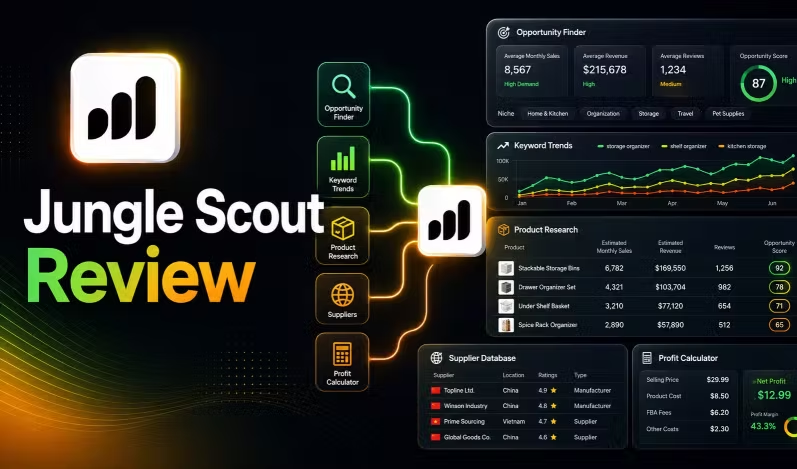
This is not a paid or commission Jungle Scout review. 5 years ago, we paid for Jungle Scout for 3 years, starting when Greg Mercer was still running it and Amazon product research was the main thing. When Jungle Scout first started, product research tools were only just beginning to show up and it quickly became part of the workflow for many new and seasoned sellers.
This is what we actually learned from using it: what it does well, where it stops being useful, and what changed after it went corporate.
What is Jungle Scout?
Jungle Scout is a product research tool built to help you decide what to sell before you commit money to a supplier.
It answers questions like:
- Is this category worth investigating?
- How many units are the top listings moving?
- How crowded is the category?
- Which keywords drive demand in this niche?
- What price range can this market support?
If your questions are "what did my account sell yesterday" or "which SKUs are draining my cash," you need something else entirely. They have a dashboard with sales data and some profit analysis, but it's not the main bread and butter. Their analysis is quite wonky with inaccurate numbers. Better dashboard type software exist at a very cheap price.
Jungle Scout works from public Amazon market data with data scraping.
What We Used It For
We used the Chrome extension constantly in the early years. It's loads a javascript inside Amazon search results page, and you can load a overlay screen to get estimated monthly sales, review counts, BSR, pricing, and estimate revenue for every visible product in the SERPs in seconds. It helped me kill bad ideas fast without going deep on any of them.
The Opportunity Finder helped us surface niches I would never have searched manually. Lots of random ideas such as sand castle sets, yoyo strings, violin stands and so on.
You set filters for estimated demand, average price, average reviews, and trend direction, and it returns categories worth investigating further.
Keyword Scout gave us the search volume data I needed to evaluate whether a niche had real demand or just felt like it did.
And finally Prroduct Tracker let us watch specific ASINs over time, because a single month of sales data gives you a snapshot, and snapshots lie. You want to see whether sales are flat, seasonal, or genuinely growing before you commit to a container.
What the Data Actually Tells You
Jungle Scout runs a reverse-engineered algorithm based on BSR to model sales volume, so the numbers reflect a plausible range rather than a verified count. Treat it as "this niche looks like it moves 400-800 units per month" and plan your supplier conversation around that range.
Fast-moving, consistent categories like basic kitchen tools, pet accessories, and fitness gear give you more reliable estimates. Niche, low-volume categories are harder to call because the underlying BSR signal is thinner.
The clearest use case is elimination. If the top 10 listings in a niche average 50 units per month, you can stop there. Before spending money, verify separately: supplier quotes, landed cost, Amazon fees via the FBA calculator, PPC bid landscape, and the review depth of the established players. Jungle Scout shows you the market, and whether your unit economics work inside it is a separate calculation entirely.
We've watched people wire money to a supplier because a score looked green, and every one of them had margin math that didn't survive the first landed cost calculation. The biggest issue that Jungle Scout introduced was that everyone started to look at the same thing.
The filters were all the same because who is looking for a so called "opportunity score" of 3? If you found something interesting and went ahead with the purchase order, expect at least 20 other people in the country to be importing the same thing as you.
These tools created the race to the bottom.
The Chrome Extension Is Still the Best Part...
But check out the reviews and it's gone downhill for a while.
With so many competitors and cheaper options, the Jungle Scout has fallen behind smaller, faster, more innovative companies. If you MUST choose one, then consider ZonGuru.
When We Outgrew It
Although we paid for 3 years, I stopped using it after year 1. Each time I kept the subscription as we were only left using it for keyword analysis.
Because it is still an all-in-one ecosystem, it was best suited for newer sellers. Today, it's evolved and rebranded many of the older products into snazzy looking user interface, but largely still similar data points.
What Changed After the Acquisition
We started using Jungle Scout when Greg Mercer was still an Amazon seller building it for himself. The tool had a specific audience and stayed focused on that audience.
After the acquisition, more plans appeared, more enterprise tiers, more features added for feature count rather than usefulness to an FBA seller. The pricing moved toward agency-scale and enterprise category analysis rather than single-brand research. The community feel, the transparency, the sense that the person who built it had the same problems you had: that's gone. It became something built for a pitch deck rather than for someone sourcing products at 10pm.
The clearest proof is Cobalt, their enterprise intelligence platform launched in 2020 and built for category managers, agencies, and large retailers managing brands above $5M in Amazon revenue. That is a different buyer entirely from the seller who made Jungle Scout what it was.
The core product still works, but the focus shifted away from the seller who needs it most. One specific thing we noticed: the pricing page now requires more time to understand than the tool itself, and that tells you something about who they're optimizing for.
Who Jungle Scout Is Actually Built For Now
Jungle Scout split its product into two distinct customer tiers. Catalyst, the plan most individual sellers know, targets sellers under $5M in annual Amazon revenue. Cobalt, their enterprise intelligence platform with custom pricing, targets brands above $5M, plus agencies, category managers, and large retailers.
Cobalt processes over 1 billion data points daily and was built for enterprise brands with teams of analysts. The Catalyst plans remain available, but the engineering attention, feature development, and pricing strategy are all pointed at the Cobalt customer.
If you're under $5M and actively researching products, the Catalyst Starter plan at $49/month still gives you the Chrome extension, Opportunity Finder, and keyword data.
You get value from the Catalyst plans if:
- You're sourcing your first or next product and need demand validation before committing to a supplier
- You want to filter out bad niches before spending money on samples
- You're tracking competitor ASINs in the months before a launch
- You're doing enough new product research each year to justify the subscription cost
The product is a weaker fit if:
- You need the roadmap and support energy of a company that considers you their primary customer
- You need operating data: sales, inventory, refunds, and fees from your own account
- You want a tool whose feature development is shaped by single-brand FBA sellers rather than enterprise category managers
What Comes After It
Once the product is live, see if the tools can do these things for you.
Alternatives
For a full breakdown, see our Jungle Scout alternatives guide.
Final Jungle Scout Review Score
FAQ
Is Jungle Scout accurate?
The estimates are based on BSR-to-sales modeling rather than Amazon order data, so they give you a plausible range rather than a verified count. Use them to eliminate ideas and identify demand ranges before you talk to a supplier.
Is Jungle Scout worth it?
For active product research, yes. If you're past the research stage and need operating data, it's the wrong tool. The price point has increased while the feature set expanded beyond what a single-brand seller actually uses.
Does Jungle Scout show my own sales data?
It shows market-level estimates based on public Amazon data and has no connection to your Seller Central account.
What changed after Jungle Scout was acquired?
More plan tiers, more features added for feature count, pricing moved toward enterprise, and the community Greg built around the tool is gone.
Can I use Jungle Scout for keyword research?
Yes. Keyword Scout gives you search volume estimates and related keyword ideas. If you have Brand Analytics access, also run Search Query Performance directly in Amazon for the same niche.
4.8 Rating · 11k+ Downloads · Trusted by Sellers








More Tested Reviews


.svg "Abstract fluid wave design with soft purple gradient")



Power My Analytics

Jungle Scout vs Gorilla ROI



.avif "Glowing abstract purple shape with psychedelic outline")
Try Gorilla ROI Free For 30 Days
Replace the Manual Spreadsheet Work and Save 40 Hours a Month